2026-09-18
What Is a Buchholz Relay?
A Buchholz relay is a gas-actuated safety device between a transformer's main tank and its conservator — it raises an alarm on a slow fault, then trips the transformer off supply before a fast one gets worse.
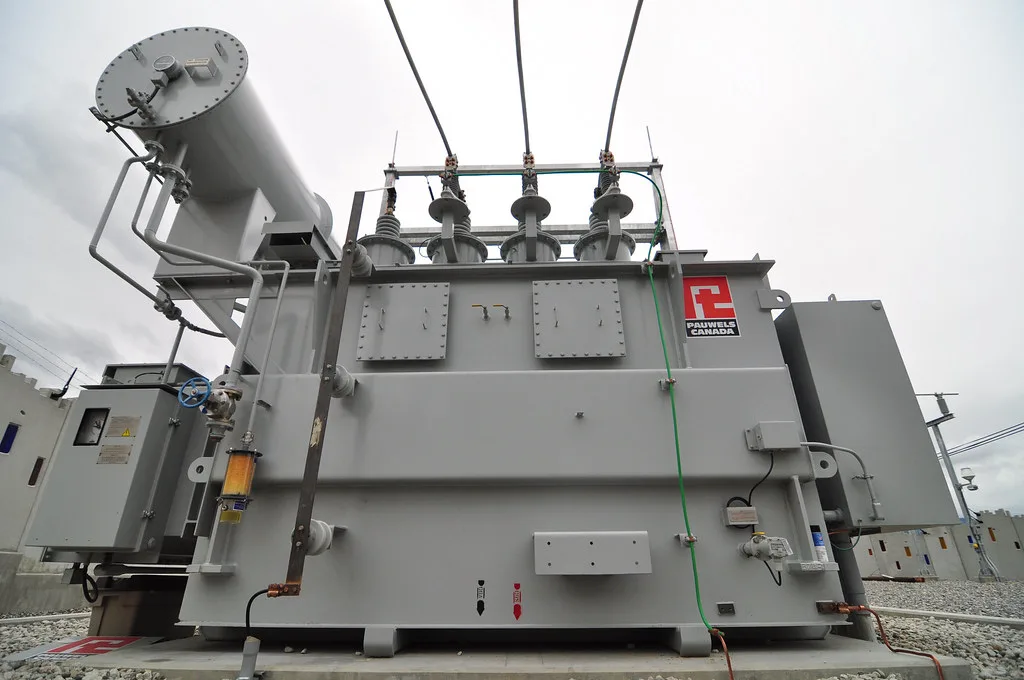
Photo: pchernik · CC BY 2.0 · openverse.org
Where does a Buchholz relay sit, and what is it actually for?
It's mounted in the pipe run between an oil-filled transformer's main tank and its overhead conservator — the only route gas or surging oil can take on its way out of the tank. German engineer Max Buchholz built the first version in 1921, and it has been standard equipment on oil-filled power and distribution transformers since the 1940s. A century-old design still gets specified on new builds because the physics it relies on — a fault makes gas before it makes a bang — hasn't changed.
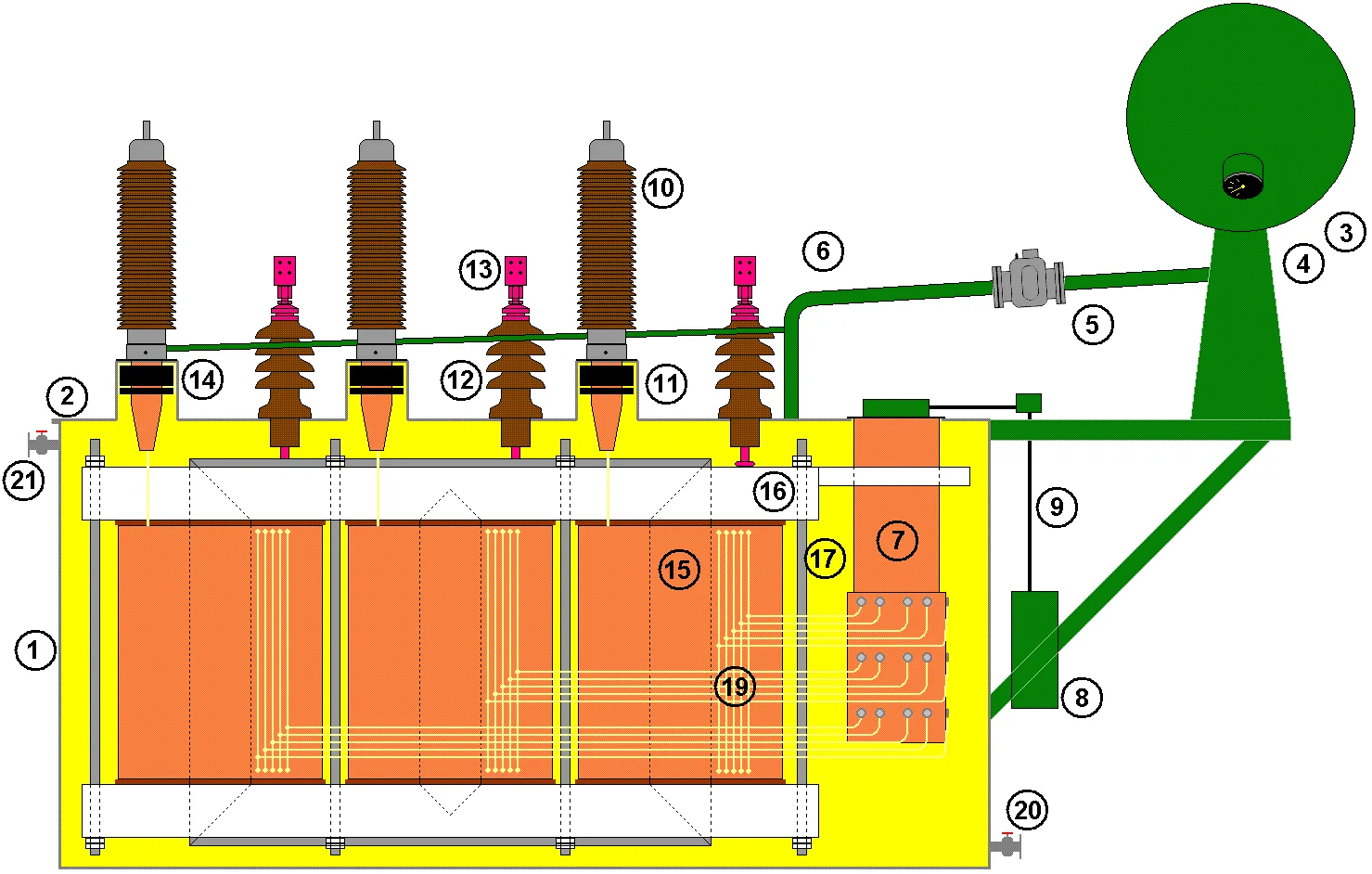
Photo: Fluppe37 (nl.wikipedia) · CC BY-SA 3.0 · openverse.org
How does the two-stage protection actually work?
A slow, low-energy fault — an overheating joint, or a winding starting to break down — generates gas gradually, which rises, collects in the relay body, and pushes the oil level down until a float switch tips and closes an alarm circuit. A violent fault — a phase-to-phase short, or a winding collapse — generates gas fast enough to drive a surge of oil straight from the tank toward the conservator. That surge strikes a vane inside the relay, tripping the transformer off supply before the fault gets worse. Two separate failure speeds, two separate responses, one device.
What's actually inside one?
Two floats and two switches, one pair per stage. The older, textbook description of a Buchholz relay uses mercury-filled tilt switches, and plenty of units built last century still run that way. The construction documented today is two ball-shaped floats paired with sealed reed switches — no liquid mercury inside the device at all. Messko's own MSAFE relay, the line we represent, confirms the same direction: protective magnetic switches, oil-tight, with every unit helium-leak tested before it ships.
What standard does it have to meet, and what does a real unit look like on spec?
The device itself is built to DIN EN 50216-2. On the MESSKO MSAFE line, a real spec sheet reads: operating temperature -40°C to +115°C, IP66 ingress protection to DIN EN 60529, a choice of DN25, DN50, DN80 or G1½ threaded connections, and up to four alarm or trip contacts per switch. Each unit also carries a test button, so maintenance staff can simulate an alarm or trip signal without breaking into the oil piping.
Photo: vaxomatic · CC BY 2.0 · openverse.org
What we see, representing this line in Taiwan
We've represented Messko's protective-devices line, Buchholz relays included, for 10+ years, and most of the enquiries we get aren't about the relay in isolation — they're a spec question tied to a specific transformer build: conservator flange size, contact configuration, ambient rating for the installation site. That's the kind of check our engineering team — which includes people who previously worked inside Fortune Electric and Allis Electric — handles directly rather than passing back to the factory.
Talk to our engineering team
Specifying protection for a new transformer build?
Send us the conservator size and connection type and we'll confirm the right MESSKO MSAFE configuration and a real lead time.
Contact Us